Inside the Private Court Governing Modern Russia

On February 21, 2022, Vladimir Putin convened his Security Council and staged what looked like consultation. Cameras rolled. Ministers shifted uneasily in their chairs. Intelligence chiefs stumbled through prepared answers. One by one, senior officials endorsed the recognition of the separatist territories in eastern Ukraine, a move that would clear the final political obstacle before the largest European land war since 1945.
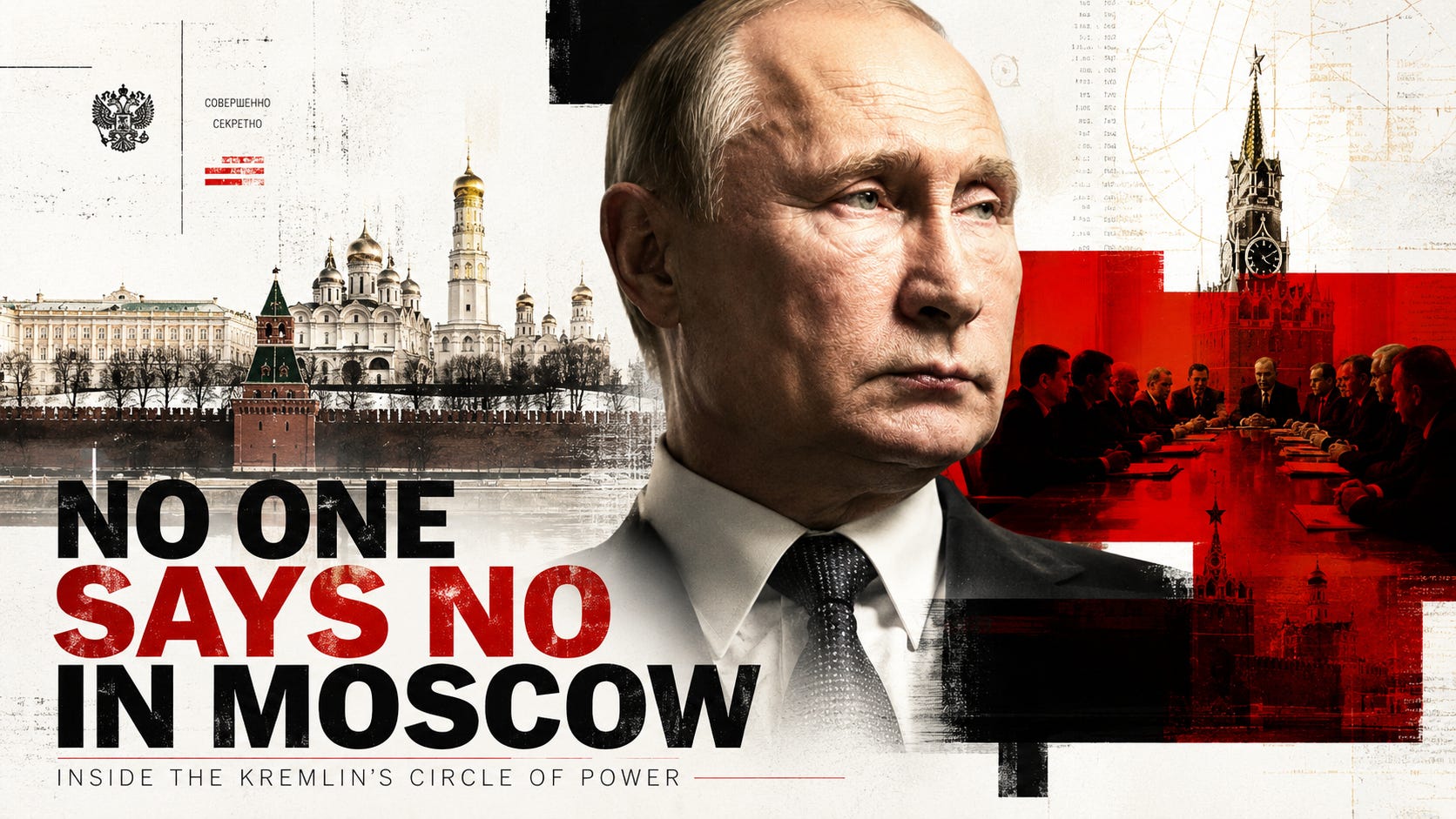
The meeting was not designed to gather opinion.
The decision had already been made.
It was a ritual of submission.
Several men in that room appeared visibly uncomfortable. Sergei Naryshkin, the head of Russia’s foreign intelligence service, hesitated while speaking. Putin interrupted him sharply, publicly humiliating one of the most powerful figures in the country. The exchange lasted seconds. But it exposed something larger than personal intimidation. It revealed the architecture of modern Russian power: loyalty performed under pressure, obedience made public, compromise shared collectively so that nobody can leave clean.
Authoritarian governments often rely on fear. Putin’s Russia relies on implication.
Not merely loyalty. Participation.
That distinction matters.
The Kremlin’s upper ranks are not held together by ideology alone, nor by patriotism, nor by coherent national vision. The bond is transactional and deeply personal. Wealth, security, status, legal protection and access all flow downward from a single center. In return, silence and obedience flow upward.
The arrangement resembles less a conventional state than a feudal court fused with the instincts of organized crime.
For years, Western observers tried to understand Russia through the language of institutions: parliament, ministries, parties, constitutions, elections. Much of that vocabulary now feels almost decorative. The real mechanics of power lie elsewhere, in personal proximity to Putin, access to resources, control over patronage networks and the constant management of fear.
Russia today functions through a hierarchy of dependence.
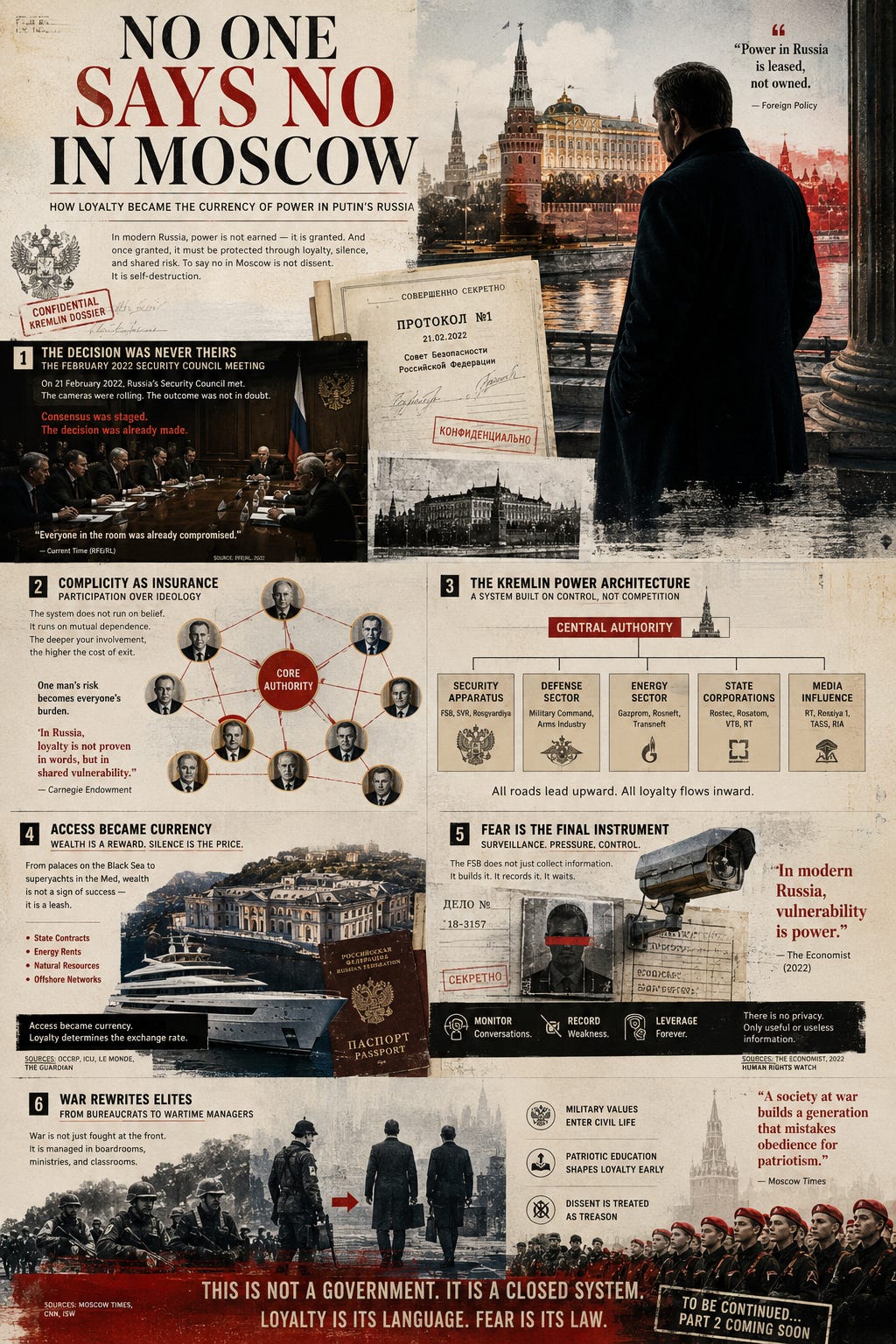
At the center stands Putin himself, not simply as president, but as arbiter, distributor and final owner of political survival. Around him orbit competing factions often referred to by Russian analysts as “clans,” loose but influential circles tied to strategic industries, state contracts, security organs and regional influence. Energy, defense, transport, finance, agriculture: each sector has beneficiaries. Their fortunes rise or collapse according to Kremlin favor.
The Russian elite does not operate like a modern ruling class protected by stable law. It operates more like tenants living on leased ground.
Everything can be revoked.
A palace seized. A company nationalized. A corruption case opened retroactively. A privatization deal from the 1990s suddenly declared invalid three decades later. In Putin’s Russia, property rights exist only until political usefulness expires.
This instability is not accidental. It is deliberate.
Predictability creates independence. Independence creates alternatives. Alternatives create threats.
So uncertainty itself becomes a governing instrument.
The Russian state has spent years building a political environment where nearly every influential figure carries some degree of vulnerability, financial, criminal, personal or political. Complicity acts as insurance. When everyone is implicated, betrayal becomes dangerous.
The Soviet Union once ruled through ideology and bureaucracy. Putin’s Russia rules through access and exposure.
That difference explains why public loyalty rituals matter so much.
Inside the Kremlin, access to Putin is political oxygen. Officials compete not merely for influence but for visibility. Entire careers depend on remaining inside the shrinking circle of relevance around the president. A man ignored by Putin for six months may effectively become politically dead.
This dynamic has transformed governance into something closer to court politics than institutional administration. Ministers, oligarchs, governors and security chiefs maneuver constantly for relevance while avoiding the appearance of excessive ambition, itself a punishable offense.
The Kremlin rewards usefulness. It distrusts independence.
That is why technocrats remain limited. Russia’s prime minister, Mikhail Mishustin, is often described as competent and managerial. But competence alone does not guarantee succession in Putin’s Russia. Administrative skill matters less than political reliability and network strength.
The men considered serious contenders in any future post Putin order are not necessarily the most capable administrators. They are the figures embedded deepest within the patronage web: men tied to security services, regional influence, propaganda structures or wartime administration.
The war in Ukraine accelerated this transformation dramatically.
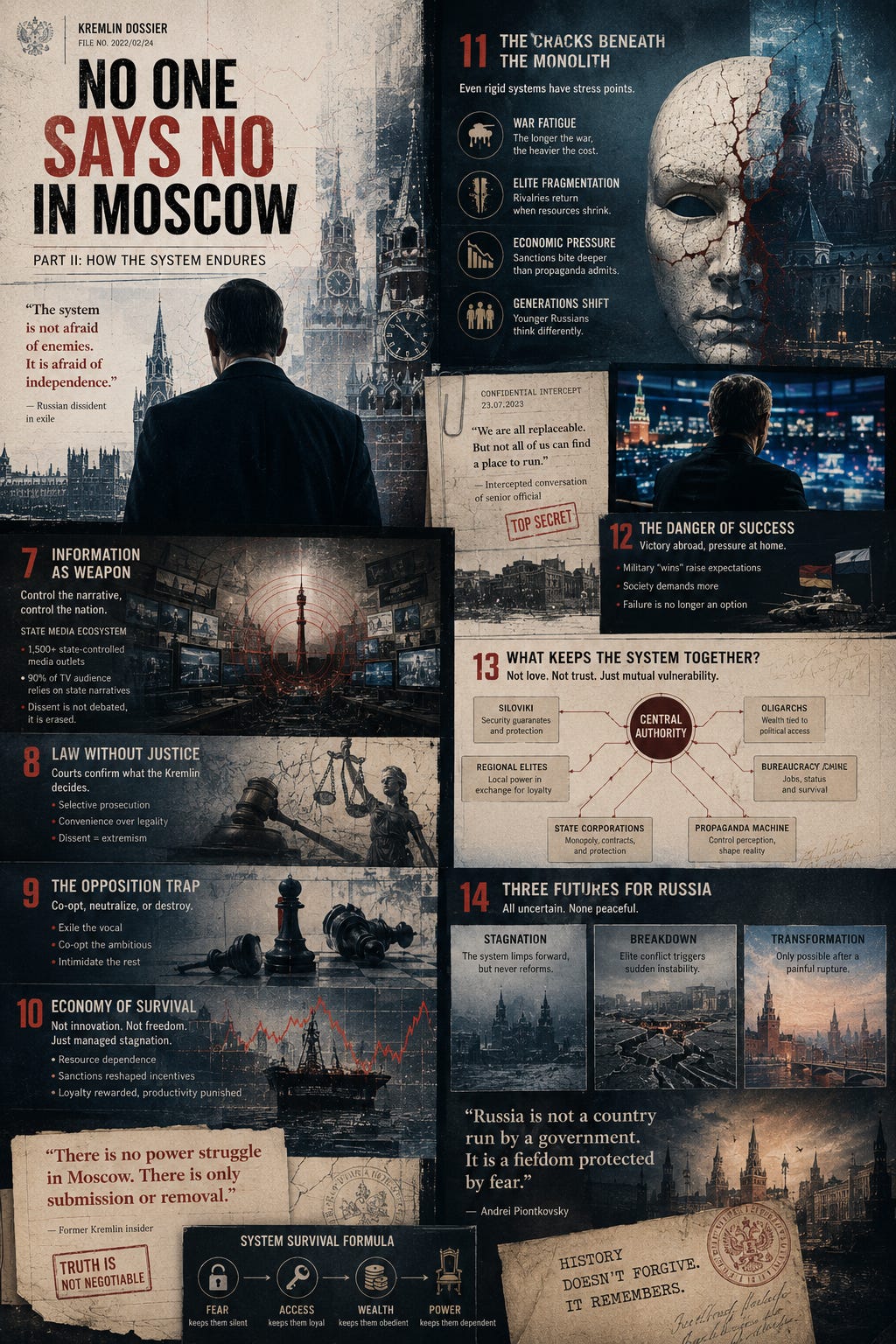
Conflict did not merely militarize Russian foreign policy. It reshaped the internal balance of power.
Since 2022, the Kremlin has worked aggressively to elevate a new wartime elite, soldiers, propagandists, military administrators and security loyalists presented as “true patriots” in contrast to the oligarchic class that emerged after the Soviet collapse.
This serves multiple purposes simultaneously.
It disciplines older elites by reminding them they are replaceable.
It creates a new social class whose status depends entirely on the continuation of Putin’s political order.
And it injects militarized nationalism deeper into civilian life.
Veterans are increasingly inserted into schools, municipal administration and patriotic education campaigns. Young Russians are taught not only history but military familiarity, drones, tactical training and battlefield heroism. The state portrays war not as tragedy but as moral purification.
The message is unmistakable: legitimacy now comes through sacrifice and loyalty to the state’s wartime narrative.
Yet much of this remains theater.
Many so called wartime figures entering bureaucracy are not frontline soldiers at all. Some are pre existing officials who acquired symbolic military credentials through carefully managed service assignments away from direct combat. Heroism itself becomes bureaucratically manufactured.
Modern Russia often operates this way, symbolism first, authenticity second.
Even anti corruption campaigns function less as ethical reform than selective enforcement.
Corruption inside Russia is not an aberration within the governing order. It is one of its operating principles. Wealth accumulation has long served as both reward and trap. Officials enrich themselves within unofficial boundaries while remaining permanently vulnerable to prosecution if political winds change.
The state can accuse almost anyone at almost any time.
That flexibility is valuable.
A governor becomes inconvenient? Launch an investigation.
An oligarch drifts politically? Revisit an old privatization agreement.
A business group loses Kremlin protection? Nationalize assets under anti corruption rhetoric.
The legal process becomes secondary. The point is control.
This atmosphere has intensified under wartime conditions. Sanctions, economic pressure and military expenditure have increased competition inside elite circles. Shrinking resources sharpen rivalries. The war has generated immense profit opportunities for some sectors, defense contracts, reconstruction projects and sanctions evasion networks, while simultaneously narrowing overall economic stability.
The result is a political class both enriched and deeply insecure.
Contrary to simplistic Western assumptions, not all Russian elites are ideological zealots. Many built their fortunes precisely because Russia remained integrated with global finance and European markets. Villas in Italy, accounts in Switzerland, children educated abroad, these were not contradictions to elite life. They were central features of it.
Even now, traces of that arrangement survive.
Some sanctioned figures continue to maintain indirect foreign assets through relatives or intermediaries. Others navigate legal loopholes and alternative jurisdictions. The relationship between Russian wealth and Western financial infrastructure never disappeared entirely. It merely became more discreet.
Still, fear remains the ultimate adhesive.
Russia’s intelligence and security services monitor elite behavior relentlessly. Files exist on everyone. Conversations, finances, loyalties, vulnerabilities. In such an environment, trust erodes quickly. Cooperation becomes tactical rather than sincere.
That creates a paradox at the heart of Putin’s Russia.
The state appears rigid from the outside but internally operates through constant tension.
Clans compete quietly. Security agencies monitor one another. Regional interests collide. Personal ambitions remain suppressed but never eliminated. Putin’s authority holds these pressures together partly because he alone balances them.
Which raises the most important question in Russian politics:
What happens when he no longer can?
Every serious actor inside the Kremlin understands the same reality: Putin is aging. No political architecture built entirely around one man escapes the succession problem forever.
That awareness shapes elite behavior already.
Some position themselves carefully for a future transition. Others build networks within the military, bureaucracy or regional structures. Several cultivate influence over occupied Ukrainian territories, understanding that wartime administration itself may become a source of future political capital.
But succession in highly personalized states is rarely orderly.
The danger for Russia is not simply leadership change. It is the absence of agreed rules for leadership change.
Stable countries survive leaders because institutions outlast personalities. Russia’s modern order has done the opposite. It concentrated authority so completely around Putin that uncertainty now grows with every passing year.
If the war eventually ends, the pressures currently suppressed by mobilization may return violently to the surface: economic stagnation, budget strain, elite competition, social exhaustion, regional dissatisfaction and disputes over shrinking resources.
War postpones many questions. It rarely eliminates them.
For now, Putin’s court remains intact. Loyalty is rewarded. Dissent is isolated. Public unanimity is carefully choreographed. But authoritarian stability often appears strongest shortly before succession anxiety begins consuming it from within.
The televised Security Council meeting in February 2022 now feels, in retrospect, less like the beginning of the Ukraine war than a snapshot of the Russian state in its purest form.
A room full of powerful men.
None powerful enough to say no.
I found this article fascinating. the insights. but this I found quite interesting and frightening.
“Veterans are increasingly inserted into schools, municipal administration and patriotic education campaigns. Young Russians are taught not only history but military familiarity, drones, tactical training and battlefield heroism. The state portrays war not as tragedy but as moral purification.”