Why Nobody Can Fix Britain?!

Britain promised change in 2024. Instead, it got deeper stagnation, rising debt, and a political system that can’t fix itself. This is the real story behind the UK’s slow decline.
I remember the night Britain decided it had had enough.
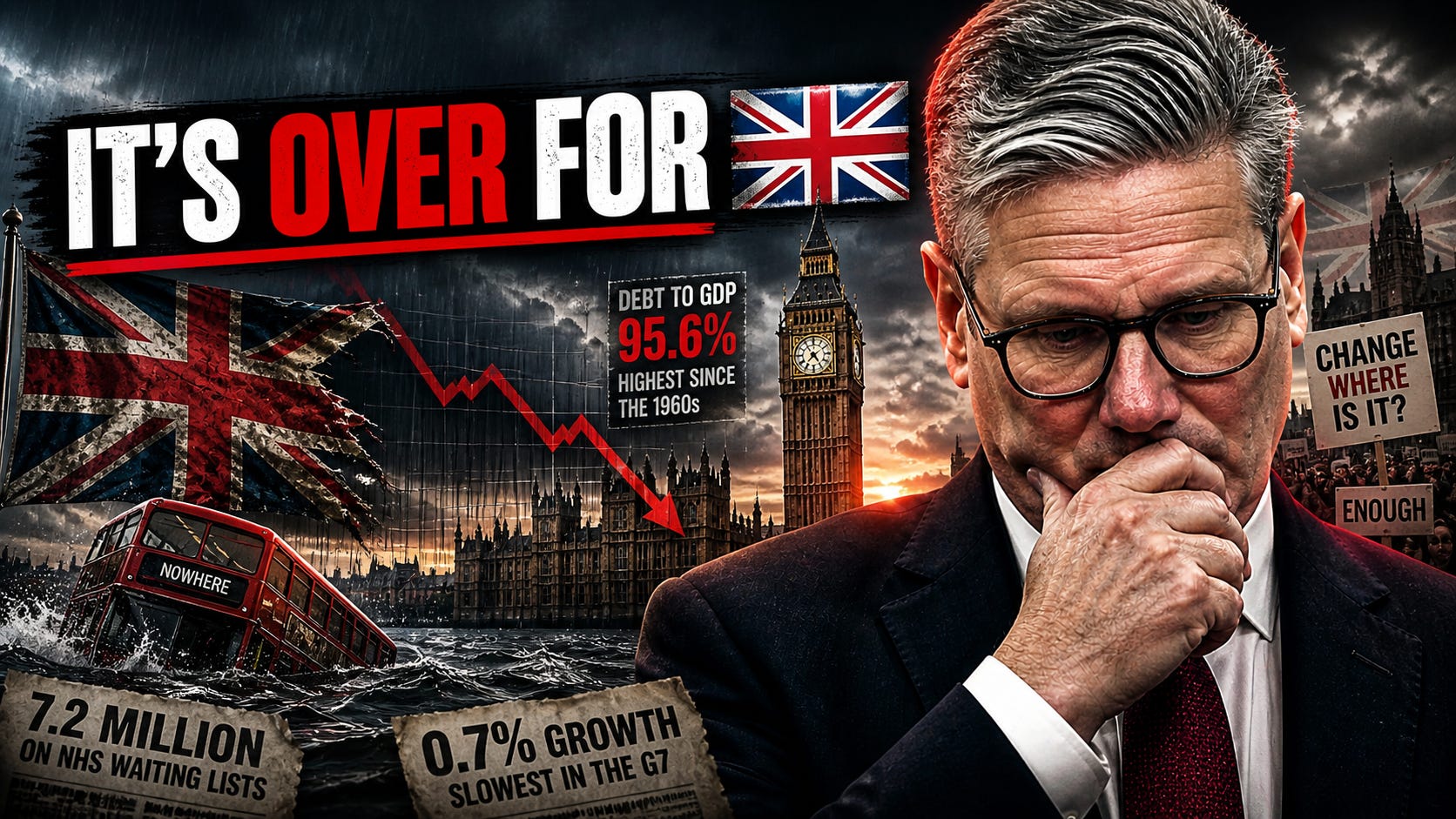
July 4th, 2024. The air felt like a reset button had finally been pressed. Fourteen years of Conservative rule swept aside in a single electoral wave. Keir Starmer stood at the podium, calm, deliberate, almost technocratic in tone, promising something deceptively simple. Change.
The word landed because people needed to believe it.
A country exhausted by stagnation convinced itself that the machinery of government, once handed over to steadier hands, would begin to function again. Hospitals would clear their backlogs. Housing would become affordable. Growth would return, almost as if it had only been waiting for permission.
That belief did not survive the year.
Today, Britain feels less like a country that chose the wrong leader and more like a system that has forgotten how to produce the right outcomes. Debt is brushing levels not seen since the postwar decades. Growth is anaemic. Millions remain trapped in NHS waiting lists. And Starmer, elected as a corrective, has instead become another casualty of the same machine.
It is tempting to frame this as failure. It is more accurate to call it inevitability.
The Illusion of Control
Political narratives depend on the idea that leaders shape outcomes. That elections matter in a direct, mechanical way. Remove one party, install another, and the system adjusts accordingly.
Britain has quietly disproven that idea.
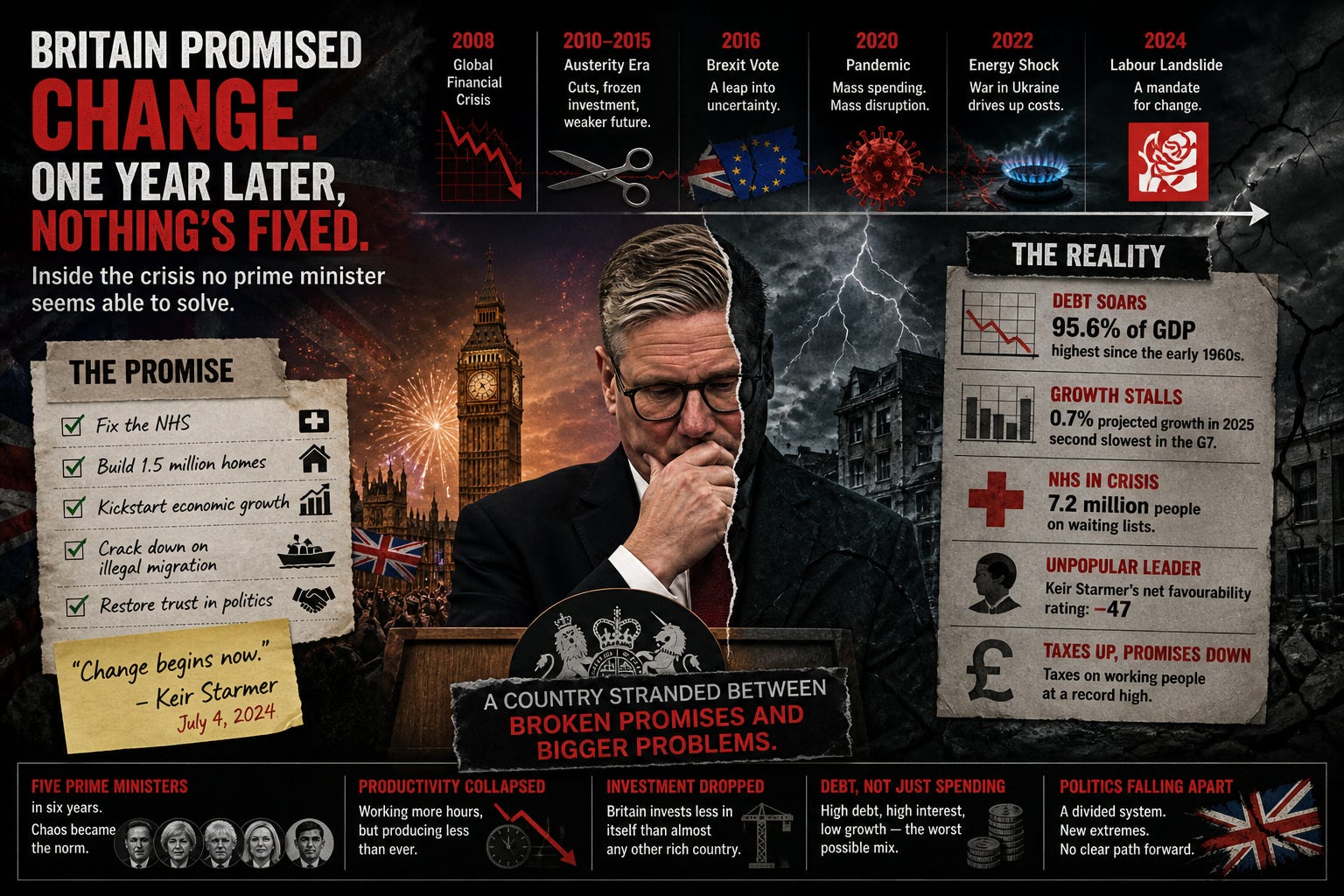
Before Starmer, there were five prime ministers in less than a decade. David Cameron, Theresa May, Boris Johnson, Liz Truss, Rishi Sunak. Each arrived with a mandate. Each left with diminished authority. The churn itself became the story.
Starmer was supposed to end that volatility. Instead, he has been absorbed by it.
Broken promises have become the headline version of his premiership. Taxes rising despite pledges. Housing targets missed by wide margins. Migration numbers climbing rather than falling. Scandals reappearing in a government that promised to eliminate them.
But focusing on those failures misses the larger point.
Even if every pledge had been fulfilled, the underlying trajectory would not have changed much.
Because Britain’s problems are not political mistakes. They are structural constraints.
The Lost Growth Engine
The British economy did not collapse overnight. It stalled, quietly, after the 2008 Global Financial Crisis and never truly restarted.
The numbers are brutal in their simplicity. If pre-2008 trends had continued, average incomes would be roughly a third higher today. That gap is not a recession. It is a permanent loss of economic potential.
The root cause is productivity. Or more precisely, the absence of it.
British workers are not working less. They are working more. The difference is that they are producing less per hour than their peers in comparable economies. The country has starved itself of capital, infrastructure, and technological investment. The tools that make workers more productive simply have not been deployed at scale.
This is not an accident. It is policy.
After the crisis, austerity became the governing doctrine. Under Cameron and George Osborne, public spending was cut aggressively in the name of fiscal discipline. Infrastructure projects slowed. Public services hollowed out. Long-term investment became politically inconvenient.
For a brief period, the books looked cleaner.
Then reality intervened.
The pandemic forced massive spending. The energy shock following the war in Ukraine compounded it. Debt surged anyway, but without the growth that might have made it manageable.
Then came Brexit.
The Brexit referendum did not just redraw trade relationships. It introduced uncertainty into the core of the British economy. Investment slowed. Firms hesitated. Productivity took another hit.
Economists still debate the exact magnitude, but the direction is not controversial. Britain made itself less efficient and more isolated at the same time.
The result is a country trapped in a loop.
To fix public services, it needs growth.
To generate growth, it needs investment.
To invest, it needs fiscal space.
And it has none.
Debt Without Growth
There is a version of this story where high debt is manageable. The United States runs large deficits but grows fast enough to sustain them. Japan carries enormous debt but finances it domestically at low cost.
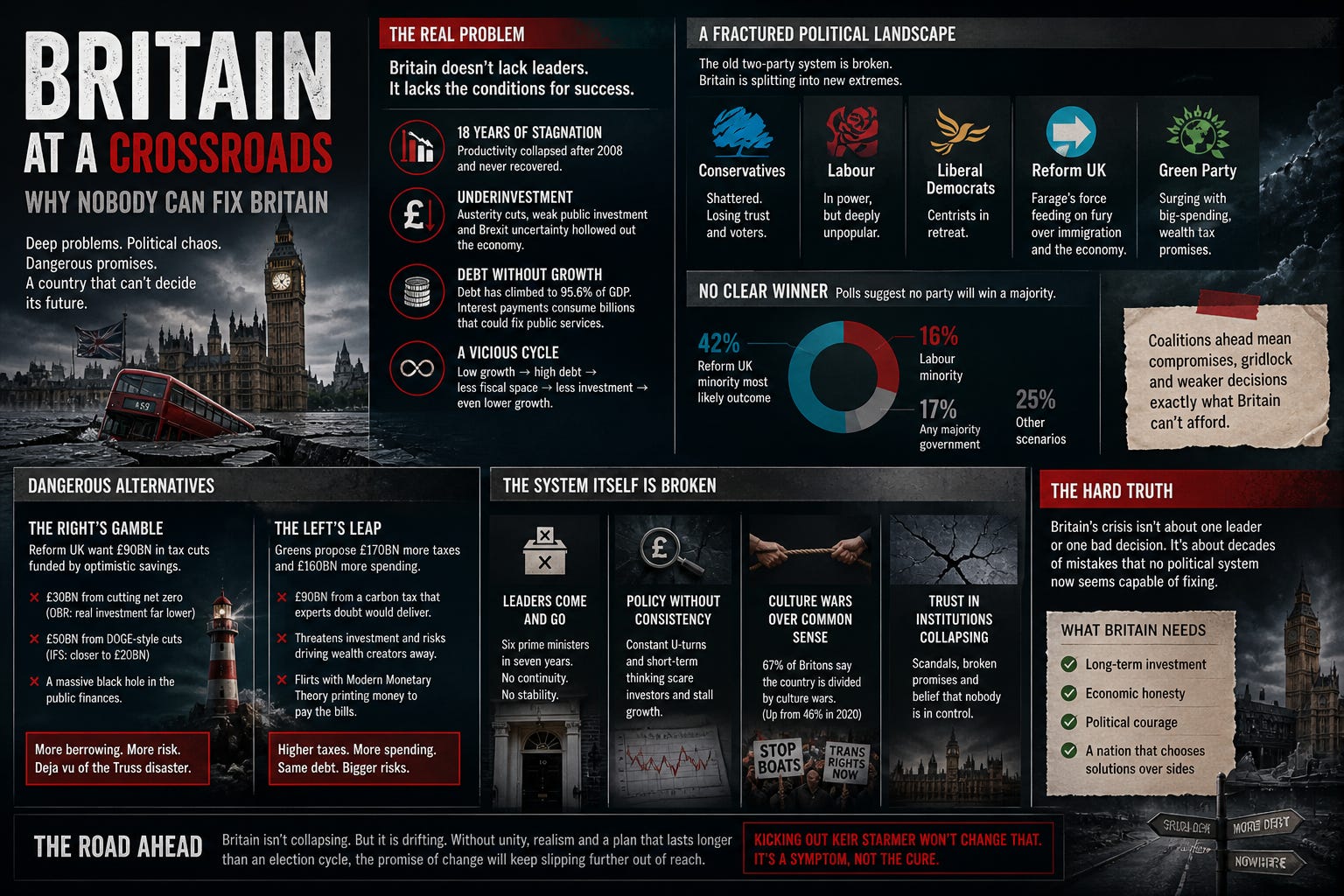
Britain has managed to achieve the worst combination. High debt with weak growth and rising borrowing costs.
Interest payments now consume a significant share of government revenue. That is money that cannot be spent on infrastructure, healthcare, or education. It is simply the cost of past decisions.
This is where Starmer’s predicament becomes clear.
Any serious attempt to repair Britain requires spending. On transport. On energy. On housing. On skills. On technology. But increasing spending risks spooking markets already sensitive to fiscal instability.
The ghost of Liz Truss still lingers. Her brief experiment with unfunded tax cuts triggered a market backlash so severe that it effectively ended her premiership within weeks.
That episode did not just remove a leader. It narrowed the policy space for everyone who followed.
A Fractured Political System
If the economic constraints were not enough, Britain’s political landscape has splintered.
The old equilibrium was simple. Two major parties, alternating power, anchored near the centre. That system provided predictability, even when it failed to deliver results.
That equilibrium is gone.
On the right, Nigel Farage has rebuilt a populist force that feeds on dissatisfaction with both Conservatives and Labour. On the left, the Greens are drawing younger voters away from Labour with promises of more radical economic change.
The result is fragmentation.
Polls increasingly suggest that no party can secure a clear majority. Coalition governments, by definition, dilute decision-making. Every policy becomes a negotiation. Every reform becomes a compromise.
This is precisely the opposite of what Britain needs.
Structural problems require decisive action sustained over years. Political fragmentation produces short-termism and gridlock.
Even worse, some of the alternatives on offer are economically incoherent.
Large unfunded tax cuts dressed up as efficiency gains. Massive spending increases justified by optimistic revenue assumptions. Casual flirtations with theories that ignore basic fiscal constraints.
This is not a criticism of ideology. It is a recognition of arithmetic.
You cannot simultaneously cut taxes, increase spending, and reduce debt without either growth or borrowing. Britain currently has neither the growth nor the appetite for more borrowing.
The Myth of the Fix
There is a persistent belief that somewhere, someone has a plan. A blueprint waiting to be implemented by the right leader at the right moment.
Britain does not suffer from a lack of ideas. It suffers from the inability to execute any of them at scale.
The system is too constrained economically and too divided politically.
Replacing Starmer will not change that. Replacing his successor will not change it either.
The country is dealing with the accumulated consequences of decisions made over decades. Underinvestment. Policy reversals. Strategic ambiguity. Political short-termism.
These are not problems that yield to electoral cycles.
They require consistency, patience, and a level of political consensus that Britain currently lacks.
What Comes Next
There is no clean resolution to this story.
The most likely outcome is not collapse, but drift. Slow growth. Periodic crises. Leadership churn. Incremental fixes that never quite add up to transformation.
Britain will continue to function. It will remain wealthy by global standards. But it will feel increasingly like a country falling behind its own expectations.
That is the real crisis.
Not that Britain is failing outright, but that it is no longer capable of delivering the progress it once took for granted.
On election night in 2024, the country believed it had chosen change.
What it actually revealed was something more uncomfortable.
There may be no one left who can deliver it.
Hi - this content is lifted from a recent video by 2&20 on YouTube with the same name. Please give credit or remove this post. Thanks.
Interesting take on GB. Basically a long string of bad decisions (mostly from conservatives) including Tax cuts for the wealthy with out replacement revenues, no investment in infrastructure or public services (health care, education et la) a global “great” recession and a poor response to a global pandemic causing supply side delays pushing inflation to the highest levels since the early 80’s.
What could possibly go wrong for the working people.
If this sounds familiar, that’s because we on the same journey here in the USA, only a few years behind because we had a some years of sanity and investment with Obama and Biden along the way. The destruction should be complete here in the next year or two….